
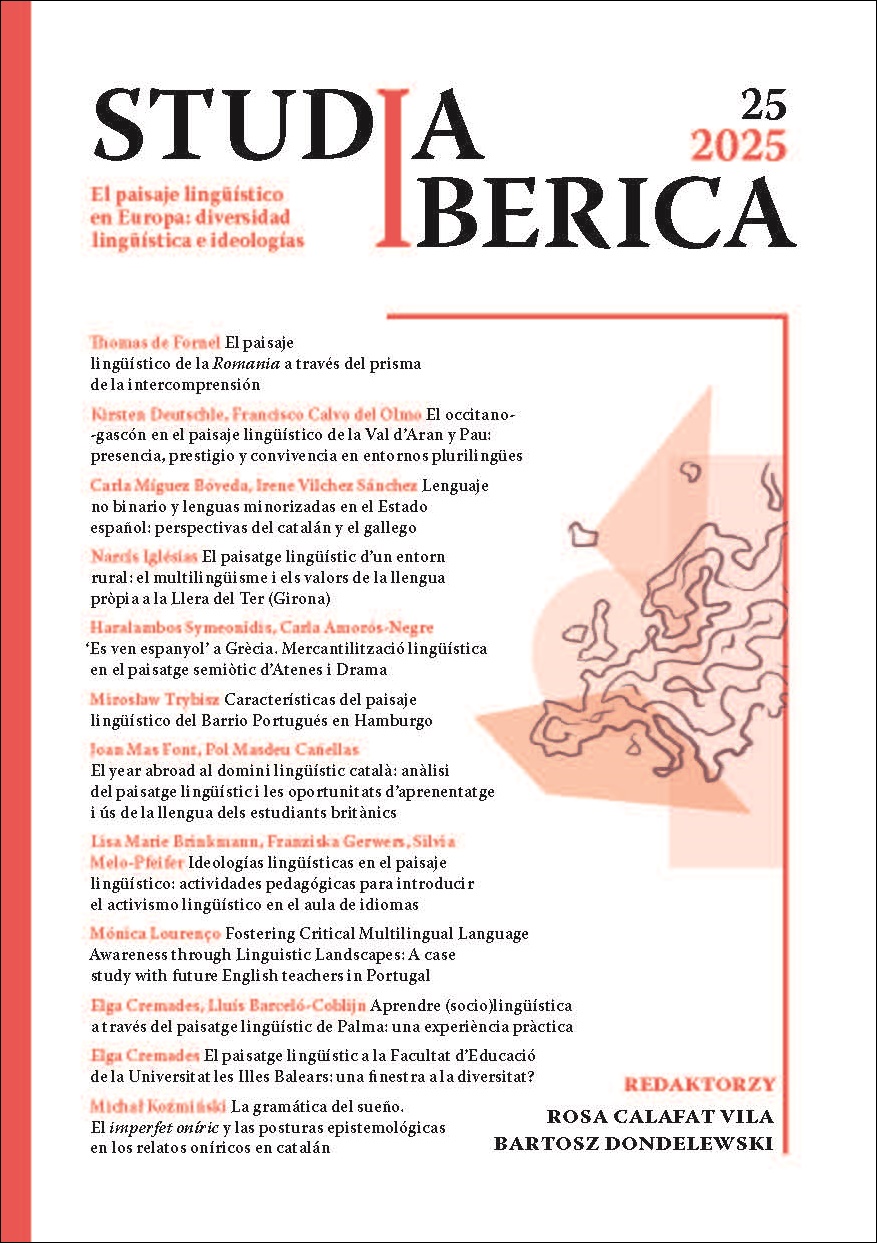
Lenguaje no binario y lenguas minorizadas en el Estado español
Perspectivas del catalán y el gallego
DOI:
https://doi.org/10.12797/SI.25.2025.25.03Słowa kluczowe:
Catalan, Galician, minoritized languages, non-binary language, normalizationAbstrakt
NON-BINARY LANGUAGE AND MINORITIZED LANGUAGES IN THE SPANISH STATE: CATALAN AND GALICIAN PERSPECTIVES
Non-binary language (NBL) is a burning issue, especially in hegemonic languages. In the context off the Spanish State, languages like Catalan and Galician have been historically marginalized by the dominance of Spanish. Thus, this article explores how this minority condition affects the development of NBL proposals in both these co-official languages. We carried a bibliographic examination of the NBL grammatical proposals in the selected languages, which were analysed to find similarities and divergences.
Catalan and Galician are typologically equal in how they mark gender: they are languages in which gender is a manifested category with a formal mark (morpheme) that specifies gender (cf. Whorf 1937). Furthermore, they have a wide diversity of dialects and even grammar, which complicates the achievement of a NBL standard. On this matter, internal variation of the languages plays a key role on the acceptance or rejection of new proposals, as their recent and changing nature does not go unnoticed for the academies. The Catalan and Galician academies have mostly remained on the sidelines of this grammatical change. However, the debate around the normativization of the proposals has recently begun: voices of the Real Academia Galega shown to be open to this change and the necessity to describe it; whereas the Institut d’Estudis Catalans branded gender neomorphemes as contradictory to the linguistic system. Even with the institutional reluctance, NBL keeps on expanding, reflecting a social and linguistic necessity that academies can’t ignore indefinitely. With the description and comparison of the proposals we hope to fuel this discussion in favour of the inclusion of everyone in the minoritized co-oficial languages of the Spanish State.
Bibliografia
3cat (2021), “Tània Verge: ‘L’objectiu de la Conselleria d’Igualtat i Feminismes és liderar la garantia dels drets humans’”, 3cat, 07.2021, https://www.ccma.cat/3cat/tania-verge-lobjectiu-de-la-conselleria-digualtat-i-feminismes-es-liderar-la-garantia-dels-drets-humans/video/6111283/, 25.03.2025.
View in Google Scholar
AMARELO, D., CEIVE, X., LOKABRENNA, M. J., MARTINS, G.
View in Google Scholar
(2020), Tranzine #1. Linguagem Alem do Binário, Monforte de Lemos, Sete Outeiros.
View in Google Scholar
BERMÚDEZ, I., CANTERO, D. (2015), Transito, Sant Cugat del Vallès, Edicions Bellaterra y Pol·len Edicions.
View in Google Scholar
BOU COSTA, O. (2021), “Teresa Cabré: ‘Les institucions han de veure que el IEC és una entitat de referència de tot el país’”, VilaWeb, 07.2021, https://www.vilaweb.cat/noticies/teresa-cabre-iec-entrevista-institut-estudis-catalans-presidenta/, 26.03.2025.
View in Google Scholar
BOYER, H. (2021), “Lengua minor(iz)ada, lengua deseada: sobre las denominaciones identitarias de productos agroalimentarios en lengua occitana”, Iztapalapa Revista de Ciencias Sociales y Humanidades, 90(1), 155-177, http://dx.doi.org/10.28928/ri/902021/aot1/boyerh. DOI: https://doi.org/10.28928/ri/902021/aot1/boyerh
View in Google Scholar
Institut d’Estudis Catalans (2022), Gramàtica de la llengua catalana (2a ed.), Barcelona, Institut d’Estudis Catalans, Barcelona, https://giec.iec.cat/, 25.03.2025.
View in Google Scholar
Institut d’Estudis Catalans (2023), El llenguatge inclusiu: compatibilitat dels recursos estilístics dels usos no sexistes amb la normativa lingüística, Barcelona, Institut d’Estudis Catalans, https://aoetic.iec.cat/wp-content/uploads/2023/10/El-llenguatge-inclusiu.pdf, 25.03.2025.
View in Google Scholar
JUNYENT, C. (2021), “El ‘totis’: una barrera contra la inclusió”, VilaWeb, 07.2021, https://www.vilaweb.cat/noticies/totis-falsa-inclusio-manipulacio-llengua/, 25.03.2025.
View in Google Scholar
JUNYENT, C. (ed.) (2021), Som dones, som lingüistes, som moltes i diem prou, Vic, Eumo Editorial.
View in Google Scholar
LÓPEZ, Á. (2019), “Tú, yo, elle y el lenguaje no binario”, La Linterna del Traductor, 19, 142150, http://www.lalinternadeltraductor.org/n19/traducir-lenguaje-no-binario.html, 23.03.2025.
View in Google Scholar
LÓPEZ, Á. (2020), “Cuando el lenguaje excluye: consideraciones sobre el lenguaje no binario indirecto”, Cuarenta Naipes, 3, 295-312, https://fh.mdp.edu.ar/revistas/index.php/cuarentanaipes/article/view/4891/5171,23.03.2025.
View in Google Scholar
LÓPEZ, Á. (2023), “El gènere a les llengües”, [en]: Moyano, J. (dir.), Guia gramatical de llenguatge no-binari, Barcelona, Raig Verd, 47-66.
View in Google Scholar
MÍGUEZ BÓVEDA, C., LÓPEZ, Á. (2023), “A linguaxe non binaria en galego. Reflexións sobre o seu uso e proposta gramatical” [en]: Carrera Fernández, M. V., Blanco Pardo, N. (coords.), As múltiples cores da vida.
View in Google Scholar
Corpos, identidades e orientacións sexuais, Vigo, Galaxia, 271-316.
View in Google Scholar
MONTEAGUDO, H. (2019), “Política lingüística en Galicia: de la normalización sin conflicto al conflicto desnormalizador” [en]: Giralt Latorre, J.,
View in Google Scholar
Nagore Laín, F. (eds.), La normalización social de las lenguas minoritarias.
View in Google Scholar
Experiencias y procedimientos para la salvaguarda de un patrimonio inmaterial, Zaragoza, Prensas de la universidad de Zaragoza, 19-55.
View in Google Scholar
MORENO CABRERA, J. C. (2021), “Políticas lingüísticas en el Estado español: del bilingüismo hegemónico al plurilingüismo armónico”, Erebea.
View in Google Scholar
Revista de Humanidades y Ciencias Sociales, 11, 21-43, https://doi.org/10.33776/erebea.v11i0.6896. DOI: https://doi.org/10.33776/erebea.v11i0.6896
View in Google Scholar
MOURE, T. (2012), Queer-emos un mundo novo. Sobre cápsulas, xéneros e falsas clasificacións, Vigo, Galaxia.
View in Google Scholar
Nós Televisión (2020), “Galego de todes? Reflexións sobre linguaxe inclusiva e non binaria”, Nós Televisión, 10.2020, https://nostelevision.gal/galego-de-todes/, 23.03.2025.
View in Google Scholar
OLID, B. (2018), “Amb ‘i’ d’inclusiva”, Jornada, 08.2018, https://catalallengua.blogspot.com/2018/08/amb-i-dinclusiva.html [publicado originalmente en https://www.diarijornada.coop/opinio/20180811/amb-i-dinclusiva;periódico actualmente inactivo], 25.03.2025.
View in Google Scholar
Real Academia Galega, Euskaltzaindia, Institut D’estudis Catalans (2021), Declaración conxunta da Real Academia Galega, a Euskaltzaindia – Real Academia da Lingua Vasca e o Institut d’Estudis Catalans, https://academia.gal/documents/35271/228920/Declaración_RAG_EUS_INSTITUT.pdf, 23.03.2025.
View in Google Scholar
Real Academia Galega, Instituto da Lingua Galega (2012), Normas ortográficas e morfolóxicas do idioma galego (23ª edición), Vigo, Editorial Galaxia.
View in Google Scholar
REGUEIRA, X. L. (2023), “Ideoloxías lingüísticas e redes sociais en galego: debates e usos lingüísticos nunha lingua minorizada no contexto da globalización” [en]: Moutinho, L. de C., Bautista, A. G., Rebelo, H., Salema, L. P., Roberto, M. T., Osório, P., Coimbra, R. L., Lima, R. M.
View in Google Scholar
Pérez, T. F. (coords.), Mundos em Mudança, Vila Nova de Famalicão, Húmus, 33-64, https://ria.ua.pt/bitstream/10773/39759/1/Mundo%20em%20Mudanca_DIGITAL_%20%28002%29.pdf, 25.03.25.
View in Google Scholar
VASALLO, B. (2021), Lenguaje inclusivo y exclusión de clase, Barcelona, Larousse.
View in Google Scholar
VÍLCHEZ SÁNCHEZ, I. (2022), Històries de vida multiaxials de persones no-binàries catalanoparlants, Trabajo Final de Grado de la Universitat Pompeu Fabra, base de datos: e-repositori, http://hdl.handle.net/10230/55230, 27.03.2025.
View in Google Scholar
VV. AA. (2023), Guia gramatical de llenguatge no-binari, Barcelona, Raig Verd.
View in Google Scholar
WHORF, B. L. (1937), “Grammatical Categories” [en]: Carroll, J. B. (ed.), Language, Thought and Reality: Selected Writings of Benjamin Lee Whorf, New York–London, The Technology Press of Massachusetts Institute of Technology–John Wiley & Sons, 87-101.
View in Google Scholar
Pobrania
Opublikowane
Numer
Dział
Licencja

Utwór dostępny jest na licencji Creative Commons Uznanie autorstwa – Użycie niekomercyjne – Bez utworów zależnych 4.0 Międzynarodowe.



