
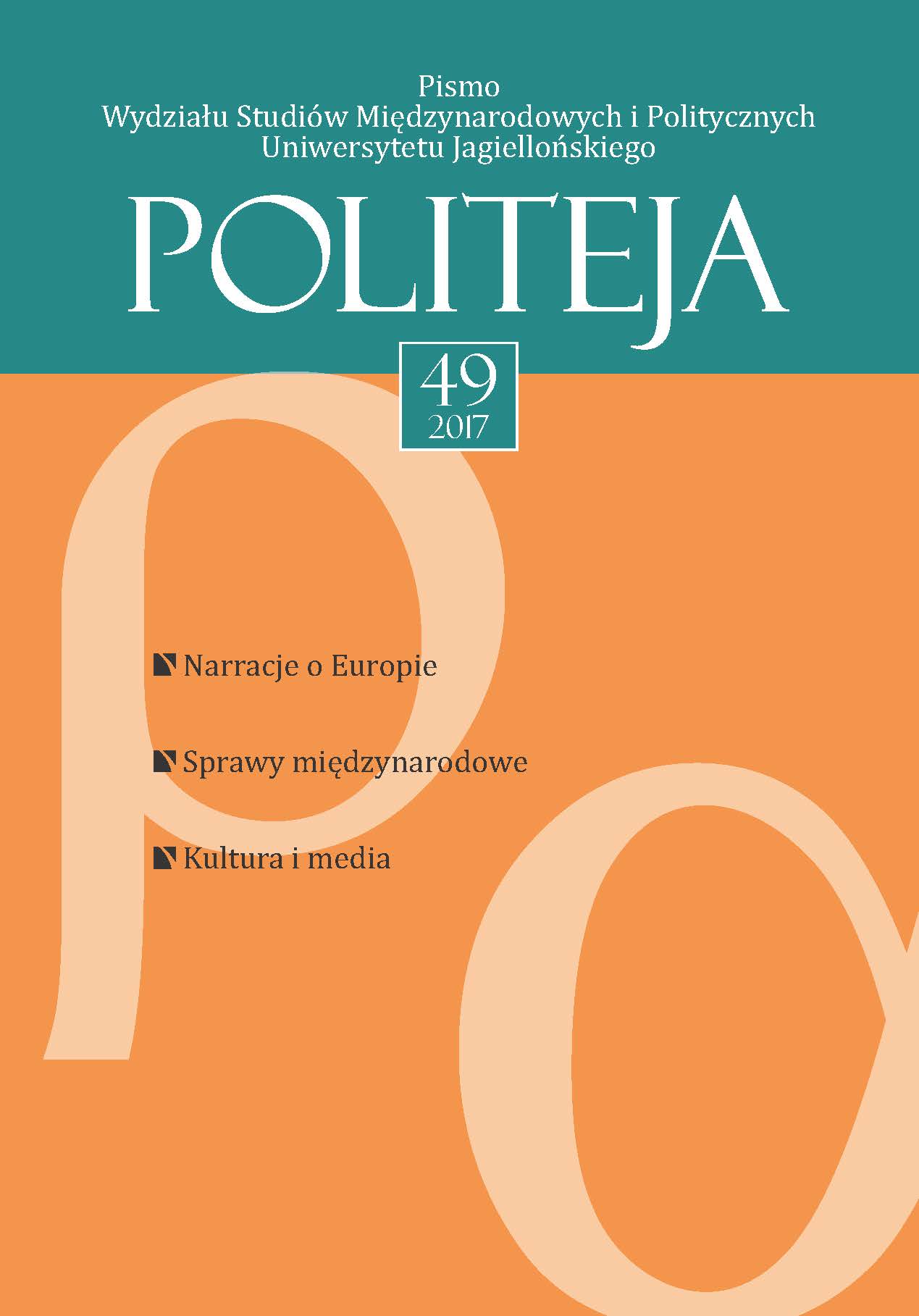
Indispensable Partner or Significant Other? German and French Media Portrayals of Poland after 25 Years of Weimar Triangle
DOI:
https://doi.org/10.12797/Politeja.14.2017.49.09Keywords:
Weimar Triangle, media discourse, European identityAbstract
With the intention of the German, French and Polish foreign ministers to bring their countries closer together after the fall of the Iron Curtain, the Weimar Triangle was founded in 1991. This setting has enabled an institutionalised regional cooperation on the governmental level as well as between the respective civil societies. However today, in a Europe of permanent crises and protracted uncertainty, a risky divergence between Germany, France and Poland seems to emerge. Since the Polish national elections in October 2015 has brought the right‑wing, nationalist Law‑and‑Justice‑party (PiS) into power, we are also witnessing a rising relevance of domestic political determinants for mutual contacts. Facing this new period of tension, where more closeness and trust would be required, discursive attitudes and strategies of ‘othering’ might gain ground and lead to increasing alienation. Based on the assumption that the portrayal of a country could be both the first step towards creating and obtaining a more inclusive or exclusive identity, this paper aims to find out the following: in how far are German and French media about to pre‑cook patterns of asymmetry and alienation? Or follow they rather an inclusive and comprehensible approach towards Poland? These questions are exemplified by the biggest centre‑left and centre‑right German and French daily newspapers Süddeutsche Zeitung, Frankfurter Allgemeine Zeitung, Le Monde and Le Figaro, whereas the corpus of data is limited to the period of the year 2016. By making use of the critical discourse analysis, this paper provides information about to what extent Poland is considered to be a close and indispensable partner as well as to where we can identify mechanisms of putting the country aside as a significant other.
Downloads
References
Sources
View in Google Scholar
Bisky J., “Zwerge, Helden, Lech Wałęsa”, Süddeutsche Zeitung, 11 March 2016, at <http://www.sueddeutsche.de/kultur/polensnationalkonservativewende‑zwerge‑helden‑lech‑wasa‑1.2902630>.
View in Google Scholar
Bubrowski H., “Rechtsstaatsverfahren der EU: Polnische Befindlichkeiten”, Frankfurter Allgemeine Zeitung, 19 January 2016, at <http://www.faz.net/aktuell/politik/euro‑paeische‑union/rechtsstaatsverfahren‑der‑eu‑polnische‑befindlichkeiten‑14023141.html>.
View in Google Scholar
“faz.de Traffic Statistics”, Alexa, at <http://www.alexa.com/siteinfo/faz.de>.
View in Google Scholar
“figaro.fr Traffic Statistics”, Alexa, at <http://www.alexa.com/siteinfo/figaro.fr>.
View in Google Scholar
Hassel F., “Kein einfacher Kowalski”, Süddeutsche Zeitung, 31 May 2016, at <http://www.sueddeutsche.de/kultur/polens‑rechte‑kein‑einfacher‑kowalski‑1.3013486>.
View in Google Scholar
Iwaniuk J., “Wroclaw 2016 veut porter les valeurs de ‘l’autre Pologne’”, Le Monde, 27 January 2016, at <http://abonnes.lemonde.fr/culture/article/2016/01/27/wroclaw‑2016‑veut‑porterles‑valeurs‑de‑l‑autre‑pologne_4854329_3246.html?xtmc=pologne&xtcr=44>.
View in Google Scholar
Martens M., “Osteuropäische Identität: Die Eingeklemmten”, Frankfurter Allgemeine Zeitung, 25 May 2016, at <http://www.faz.net/aktuell/feuilleton/debatten/iwan‑krastew‑und‑oliver‑jens‑schmitt‑zu‑osteuropa‑14250809.html>.
View in Google Scholar
Mével J.‑J., “L’Union européenne menacée par ses fractures”, Le Figaro, 18 January 2016, at <http://premium.lefigaro.fr/international/2016/01/18/01003‑20160118ARTFIG00342‑l‑union‑europeenne‑mena‑cee‑par‑ses‑fractures.php>.
View in Google Scholar
Mével J.‑J.,“UE: les pays de l’Est se rallient au projet de défense européenne”, Le Figaro Premium, 13 September 2016, at <http://premium.lefigaro.fr/international/2016/09/13/01003‑20160913ARTFIG00275‑ue‑les‑pays‑de‑l‑est‑se‑rallient‑au‑projet‑de‑defense‑europeenne.php>.
View in Google Scholar
“monde.fr Traffic Statistics”, Alexa, at <http://www.alexa.com/siteinfo/monde.fr>.
View in Google Scholar
Peters B., Galaktionow B., “Vor dem EU‑Gipfel Die Willigen und die Unwilligen”, Süddeutsche Zeitung, 17 February 2016, at <http://www.sueddeutsche.de/politik/vor‑dem‑eu‑gipfel‑die‑willigen‑und‑die‑unwilligen‑in‑der‑fluechtlingskrise‑1.2865586>.
View in Google Scholar
“Polnisches Großmanöver: Zehntausende Soldaten gegen die Angst”, Frankfurter Allgemeine Zeitung, 7 June 2016, at <http://www.faz.net/aktuell/politik/ausland/europapolen‑probt‑grossmanoever‑anakonda‑2016‑mit‑grossbritannien‑usa‑14273702.html>.
View in Google Scholar
“Pologne: le choix de l’isolement”, Le Monde, 2 November 2016, at <http://www.lemonde.fr/idees/article/2016/11/02/pologne‑le‑choix‑de‑l‑isolement_5024119_3232.html>.
View in Google Scholar
“zeit.de Traffic Statistics”, Alexa, at <http://www.alexa.com/siteinfo/zeit.de>.
View in Google Scholar
Literature
View in Google Scholar
Boulding K.E., The Image. Knowledge in Life and Society, Ann Arbor 1956. DOI: https://doi.org/10.3998/mpub.6607
View in Google Scholar
Boulding K.E., “National Images and International Systems”, Journal of Conflict Resolution, vol. 3, no. 2 (1959). DOI: https://doi.org/10.1177/002200275900300204
View in Google Scholar
Chaban N., Holland M., “Introduction: The Evolution of EU Perceptions: From Single Studies to Systematic Research”, in iidem (eds.), Communicating Europe in Times of Crisis. External Perceptions of the European Union, London 2014, at <http://dx.doi.org/10.1057/9781137331175_1>. DOI: https://doi.org/10.1057/9781137331175
View in Google Scholar
Fairclough N., “The Discourse of New Labour: Critical Discourse Analysis”, in M. Wetherell, S. Taylor, S. Yates (eds.), Discourse as Data. A Guide for Analysis, London 2001.
View in Google Scholar
Herrmann R.K., Perceptions and Behavior in Soviet Foreign Policy, Pittsburgh 1985.
View in Google Scholar
Jones P., Krzyzanowski M., “Identity, Belonging and Migration: Beyond Constructing ‘Others’”, in G. Delanty, R. Wodak, P. Jones (eds.), Identity, Belonging and Migration, Liverpool 2011.
View in Google Scholar
Keller R., Diskursforschung. Eine Einführung für SozialwissenschaftlerInnen, Wiesbaden 2007.
View in Google Scholar
Kundera M., “The Tragedy of Central Europe”, transl. by E. White, New York Review of Books, vol. 31, no. 7 (1984).
View in Google Scholar
Lang K.‑O., “Preserving the Unity of a Fragmenting Europe”, New Eastern Europe, no. 6 (2016).
View in Google Scholar
Movahedi S., “The Social Psychology of Foreign Policy and the Politics of International Images”, Human Affairs, no. 8 (1985).
View in Google Scholar
Neumann I.B., Uses of the Other. ‘The East’ in European Identity Formation, Minneapolis 1999.
View in Google Scholar
Shohat E., Stam R., Unthinking Eurocentrism. Multiculturalism and the Media, London 2014. DOI: https://doi.org/10.4324/9781315771441
View in Google Scholar
Silverstein B., “Enemy Images: The Psychology of U.S. Attitudes and Cognitions Regarding the Soviet Union”, American Psychologist, vol. 44, no. 6 (1989), at <http://dx.doi.org/10.1037/0003‑066X.44.6.903>. DOI: https://doi.org/10.1037/0003-066X.44.6.903
View in Google Scholar
Silverstein B., Flamenbaum C., “Biases in the Perception and Cognition of the Actions of Enemies”, Journal of Social Issues, vol. 45, no. 2 (1989), at <http://dx.doi.org/10.1111/j.1540‑4560.1989.tb01542.x>. DOI: https://doi.org/10.1111/j.1540-4560.1989.tb01542.x
View in Google Scholar
Szymańska A., “Information, Meinung, Macht, Manipulation. Die Rolle der Medien in den deutsch‑polnischen Beziehungen”, in D. Bingen et al. (eds.), Erwachsene Nachbarschaft. Die deutsch‑polnischen Beziehungen 1991 bis 2011, Wiesbaden 2011.
View in Google Scholar
Wodak R., “‘Us’ and ‘Them’: Inclusion and Exclusion – Discrimination via Discourse”, in G. Delanty, R. Wodak, P. Jones (eds.), Identity, Belonging and Migration, Liverpool 2011.
View in Google Scholar
Wodak R., Meyer M., “History, Agenda, Theory and Methodology. Theoretical and Methodological Aspects of Foucauldian Critical Discourse”, in iidem (eds.), Methods of Critical Discourse Studies, London 2009.
View in Google Scholar
Downloads
Published
Issue
Section
License

This work is licensed under a Creative Commons Attribution-NonCommercial-NoDerivatives 4.0 International License.



