
About the Journal

Politeja is published by the Faculty of International and Political Studies of the Jagiellonian University, where a circle has formed of academics perfectly qualified for undertaking such reflection. It seems that it is in this particular unit of the Jagiellonian University that such reflection finds a forum perfectly equipped for an in-depth and solid analysis of phenomena of present-day relevance, both cultural and political, given that it has combined units existing for a long time with newly established ones, albeit in both cases comprising experienced researchers capable of looking at the same phenomena from various vantage points.

Announcements

Important Notice – Two-Factor Authentication for Logging into the OJS System

06-11-2026

Dear Users,

Please be advised that as of October 2026, two-factor authentication (2FA) has been implemented in the OJS system.

This is an additional security measure that enhances login security and protects against unauthorized access, such as in the event of a password compromise. In addition to your username and password, the system will require you to enter a one-time code generated by an app on your phone.

Read more about Important Notice – Two-Factor Authentication for Logging into the OJS System
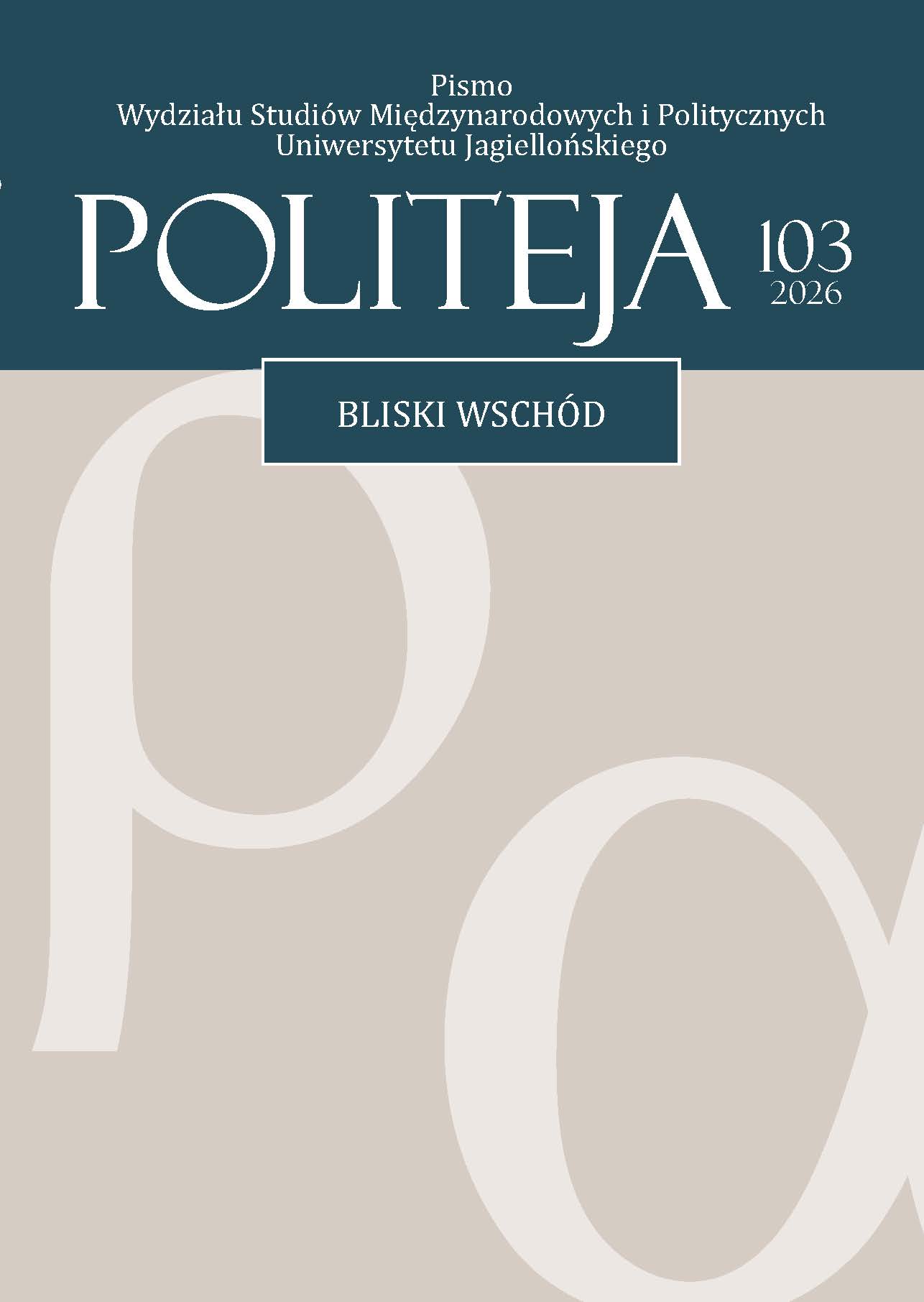
Current Issue

Vol. 23 No. 3(103) (2026)
					View Vol. 23 No. 3(103) (2026)
Published: 04-08-2026

Articles

  • Rethinking International Relations through the Middle East

    Jerzy Zdanowski
    5-25
    DOI: https://doi.org/10.12797/Politeja.23.2026.103.01
  • Ethnic Ideology of the Sudanese Rapid Support Forces (RSF)

    Jędrzej Czerep
    45-66
    DOI: https://doi.org/10.12797/Politeja.23.2026.103.03
  • Fenomen Netanjahu. Analiza wybranych aspektów orientacji wojennej Benjamina Netanjahu w izraelskiej i zachodniej debacie publicznej po 7 października 2023 r.

    Martyna Wielewska-Baka
    185-206
    DOI: https://doi.org/10.12797/Politeja.23.2026.103.10
  • Koncepcja współczesnej propagandy w świecie arabskim

    Marcin Styszyński
    67-85
    DOI: https://doi.org/10.12797/Politeja.23.2026.103.04
  • Türkiye’s Africa Policy under the AKP Transition in Instruments Between Soft and Hard Power

    Dominika Liszowska
    207-224
    DOI: https://doi.org/10.12797/Politeja.23.2026.103.11
  • Transitioning Power Exploring Candidate Selection and Leadership Succession in the Persian Gulf Monarchies

    Wojciech Grabowski, Maciej Hartliński, Robert Czulda
    87-109
    DOI: https://doi.org/10.12797/Politeja.23.2026.103.05
  • Gazociąg Turkmenistan-Afganistan‑Pakistan-Indie (TAPI). Reaktywacja?

    Joanna Modrzejewska-Leśniewska
    225-249
    DOI: https://doi.org/10.12797/Politeja.23.2026.103.12
  • Środowisko operacyjne prowincji Ghazni 2009-2014 w procesie PCR Udział kobiet w operacjonalizacji kultury

    Aleksandra Zamojska
    111-129
    DOI: https://doi.org/10.12797/Politeja.23.2026.103.06
  • Klątwa surowcowa jako determinanta rozwoju społeczno‑gospodarczego Rola polityki przemysłowej w Arabii Saudyjskiej

    Marek Świstak
    251-271
    DOI: https://doi.org/10.12797/Politeja.23.2026.103.13
  • Przemysł zbrojeniowy w państwach subregionu Zatoki Perskiej

    Jarosław Jarząbek
    131-146
    DOI: https://doi.org/10.12797/Politeja.23.2026.103.07
  • Realizacja projektu Vision 2030 w Arabii Saudyjskiej Między marzeniami a realiami budżetowymi

    Maciej Münnich
    273-295
    DOI: https://doi.org/10.12797/Politeja.23.2026.103.14
  • Od demokracji do autorytaryzmu populistycznego Tunezja ery Kaïsa Saïeda

    Ewa Szczepankiewicz-Rudzka
    131-146
    DOI: https://doi.org/10.12797/Politeja.23.2026.103.08
  • Ewolucja polityki zagranicznej Zjednoczonych Emiratów Arabskich w obliczu rywalizacji wielkich mocarstw

    Wojciech Michnik
    27-43
    DOI: https://doi.org/10.12797/Politeja.23.2026.103.02
  • Podziały etniczne w zachodnim Pakistanie jako zagrożenie dla bezpieczeństwa państwa i regionu

    Aleksander Głogowski
    297-315
    DOI: https://doi.org/10.12797/Politeja.23.2026.103.15
  • Dlaczego konsocjonalizm zawodzi w Libanie? Rola elit politycznych w systemie power-sharing

    Katarzyna Amor Dziedzic
    167-184
    DOI: https://doi.org/10.12797/Politeja.23.2026.103.09
View All Issues