
Three Bone Artefacts from Room R.23 of the East Portico at the Agora in Nea Paphos, Cyprus
DOI:
https://doi.org/10.12797//SAAC.29.2025.29.07Keywords:
amulet, bone artefacts, Cyprus, Late Hellenistic period, Nea PaphosAbstract
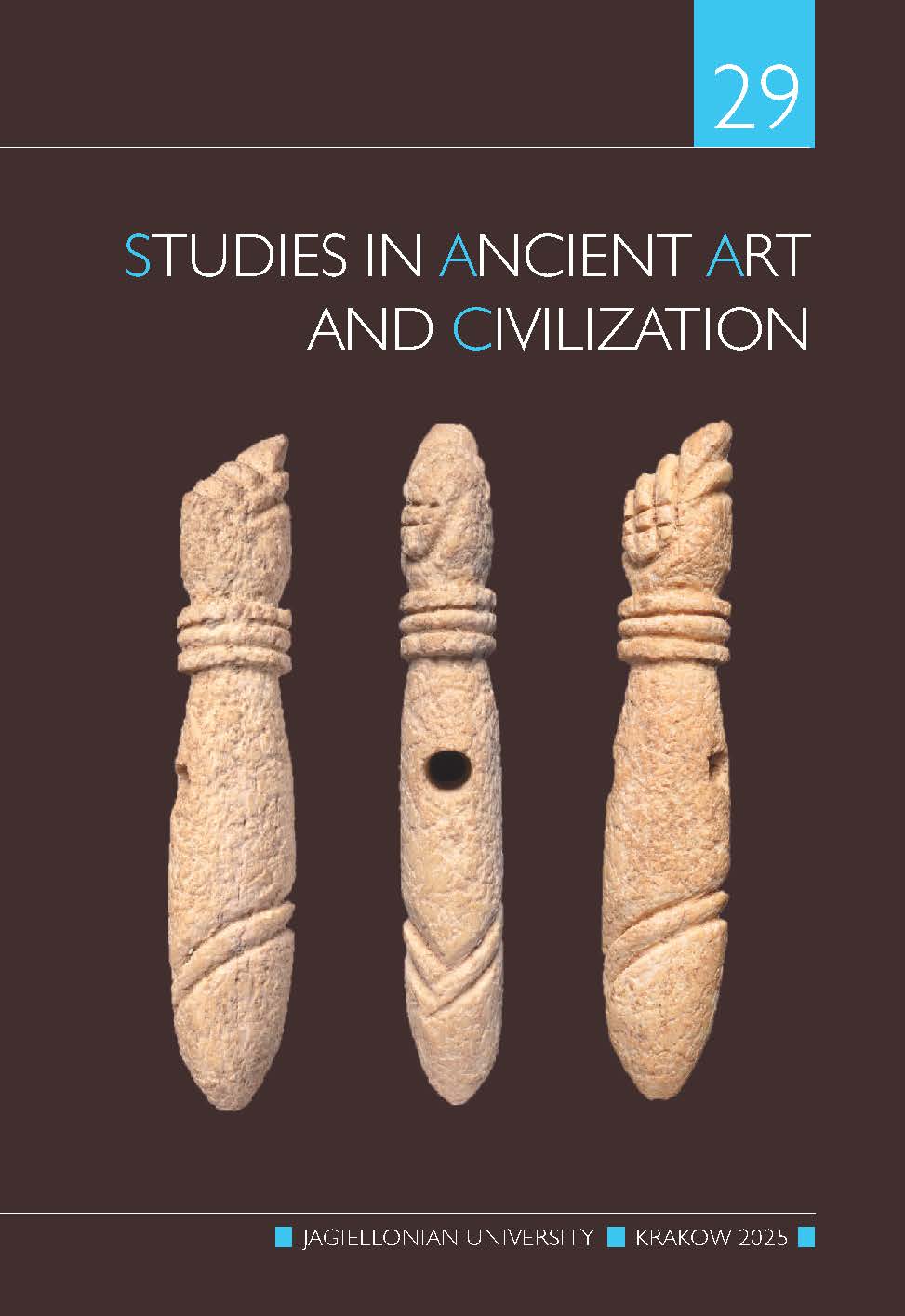
In 2011-2019, during the research of the Jagiellonian University’s expedition at the Agora of Nea Paphos (Cyprus), more than 50 artefacts made of bone and related materials were discovered. This article presents an analysis of three objects unearthed in room R.23, located in the central part of the East Portico. This small assemblage, dated to the Late Hellenistic period, consists of a protective amulet depicting a mano fica and a phallus, a perforated knucklebone and a ring. Although the interpretation of this find – which also partially considers the coins found in the same context – remains uncertain, the possibility that these artefacts constituted a set of personal items should not be overlooked.
References
Ashton R. H. J. 2001. Rhodian Bronze Coinage and the Siege of Mithradates VI. The Numismatic Chronicle 161, 53-66.
Ashton R. H. J. 2009. The Only Recorded Name on Rhodian Plinthophoric Chalkoi. The Numismatic Chronicle 169, 39-43.
Ashton R. H. J. and Meadows A. 2008. The Letoon Deposit: Lycian League Coinage, Rhodian Plinthophori, and Pseudo-Rhodian Drachms from Haliartos (Yet Again) and Asia Minor. The Numismatic Chronicle 168, 111-134.
Ayalon E. 2005. The Assemblage of Bone and Ivory Artifacts from Caesarea Maritima, Israel: 1st-13th Centuries CE. Oxford. https://doi.org/10.30861/9781841718958. DOI: https://doi.org/10.30861/9781841718958
Bodzek J. 2020. Coin Finds. In E. Papuci-Władyka (ed.), Paphos Agora Project (PAP). Volume 1: Interdisciplinary Research of the Jagiellonian University in Nea Paphos UNESCO World Heritage Site (2011-2015) – First Results, 377-400. Kraków.
Bodzek J. 2022. Hellenistic Coins from the Jagiellonian University Excavations at the Hellenistic-Roman Agora of Nea Paphos (Paphos Agora Project 2011-2019): Preliminary Observations. Wiadomości Numizmatyczne 66/210, 1-19. https://doi.org/10.24425/wn.2022.141932. DOI: https://doi.org/10.24425/wn.2022.141932
Choyke A. 2010. The Bone is the Beast: Animal Amulets and Ornaments in Power and Magic. In D. Campana, P. Crabtree, S. D. de France, J. Lev-Tov and A. Choyke (eds), Anthropological Approaches to Zooarchaeology. Complexity, Colonialism, and Animal Transformations, 197-209. Oxford.
Cool H. E. M. 2016. The Small Finds and Vessel Glass from Insula VI.1 Pompeii: Excavation 1995-2006. Oxford. DOI: https://doi.org/10.2307/j.ctv17db2qh
Cox D. H. 1959. Coins form the Excavations at Curium, 1932-1953. New York.
Croft P. 2020. Animal Bones. In E. Papuci-Władyka (ed.), Paphos Agora Project (PAP). Volume 1: Interdisciplinary Research of the Jagiellonian University in Nea Paphos UNESCO World Heritage Site (2011-2015) – First Results, 453-464. Kraków.
Crummy N. 1983. The Roman Small Finds form Excavations in Colchester 1971-9. Colchester.
Dandoy J. R. 2006. Astragali through Time. In M. Maltby (ed.), Integrating Zooarchaeology: Proceedings of the 9th Conference of the International Council of Archaeozoology, Durham, August 2002, 131-137. Oxford.
Dasen V. 2015. Probaskania: Amulets and Magic in Antiquity. In D. Boschung and J. N. Bremmer (eds), The Materiality of Magic, 177-204. Paderborn. https://doi.org/10.30965/9783846757253_010. DOI: https://doi.org/10.30965/9783846757253_010
Déonna W. 1938. Le mobilier délien. In Exploration archéologiques de Délos. Fasc. 18, 347-362. Paris.
Dobosz A. 2013. Kontakty handlowe Cypru w okresie hellenistycznym w świetle odkryć amfor. Kraków.
Elliott J. H. 2016. Beware the Evil Eye: The Evil Eye in the Bible and the Ancient World. Volume 2: Greece and Rome. Eugene. https://doi.org/10.2307/j.ctv1131hck. DOI: https://doi.org/10.2307/j.ctv1131hck
Elworthy F. T. 1958. The Evil Eye: The Origins and Practices of Superstition. New York.
Faraone Ch. A. 2018. The Transformation of Greek Amulets in Roman Imperial Times. Philadelphia.
Gerçek A. 2022. Patara’dan Manus Fica ve Phallus Betimli İki Amulet. Höyük 10, 61-74. https://doi.org/10.37879/hoyuk.2022.2.061. DOI: https://doi.org/10.37879/hoyuk.2022.2.061
Gilmour G. H. 1997. The Nature and Function of Astragalus Bones from Archaeological Contexts in the Levant and Eastern Mediterranean. Oxford Journal of Archaeology 16/2, 167-175. https://doi.org/10.1111/1468-0092.00032. DOI: https://doi.org/10.1111/1468-0092.00032
Helly B. 1970. Les monnaies. In V. Karageorghis (ed.), Excavations in the Necropolis of Salamis II, 236-268. Nicosia.
Hoss S. 2020. Barbie-Bodies and Coffee Beans: Female Genital Imagery in the Mediterranean and the North-West Provinces of the Roman Empire. In T. Ivleva and R. Collins (eds), Un-Roman Sex: Gender, Sexuality, and Lovemaking in the Roman Provinces and Frontiers, 117-182. London. https://doi.org/10.4324/9781315269894-5. DOI: https://doi.org/10.4324/9781315269894-5
Jenkins G. K. 1989. Rhodian Plinthophoroi – A Sketch. In G. Le Rider (ed.), Kraay-Mørkholm Essays: Numismatic Studies in Memory of C. M. Kraay and O. Mørkholm, 101-119. Louvain-la-Neuve.
Johns C. 1982. Sex or Symbol? Erotic Images of Greece and Rome. London.
Kromann A. and Mørkholm O. (eds) 1977. Sylloge Nummorum Graecorum: The Royal Collection of Coins and Medals Danish National Museum. Egypt: The Ptolemies. Munksgaard–Copenhagen.
Larson K. A. 2018. Personal Adornment: Glass, Stone, Bone, and Shell. In A. M. Berlin and S. C. Herbert (eds), Tel Anafa II, iii: Decorative Wall Plaster, Objects of Personal Adornment and Glass Counters, Tools for Textile Manufacture and Miscellaneous Bone, Terracotta and Stone Figurines, Pre-Persian Pottery, Attic Pottery, and Medieval Pottery, 79-136. Ann Arbor.
Lichocka B. 1985. Un type de Zeus sur les monnaies hellénistique de Nea Paphos. In Θ. Παπαδόπουλλος [T. Papadopoulos] and Σ. Α. Χατζηστυλλής [S.A. Chatzestylles] (eds), Πρακτικά του δεύτερου Διεθνούς Κυπρολογικού Συνεδρίου: Λευκωσία, 20-25 Απριλίου 1982. Αρχαίοντμήμα 1 [Praktiká tou deúterou Diethnoús Kyprologikoú Synedríou: Leukōsía, 20-25 Aprilíou 1982. Archaíontmī́ma 1], 327-333. Nicosia.
Lichocka B. 1998. Brązowe monety z mennicy ptolemejskiej w Pafos. Obserwacje na temat niektórych monet znalezionych przez Polską Misję Archeologiczną. In W. A. Daszewski and H. Meyza (eds), Cypr w badaniach polskich. Materiały z Sesji Naukowej zorganizowanej przez Centrum Archeologii Śródziemnomorskiej UW im. prof. K. Michałowskiego, 119-129. Warszawa.
Lorber C. C. 2025. Coins of the Ptolemaic Empire, Part 2: Ptolemy V through Cleopatra VII. Volume 1: Historical Introduction, Volume 2: Catalogue of Precious-Metal Coins, Volume 3: Catalogue of Bronze Coins. Turnhout. DOI: https://doi.org/10.1484/M.NS-EB.5.136324
Łajtar A. 2021. A Weight of Seleucia in Pieria in Nea Paphos. Études et Travaux 34, 255-263. https://doi.org/10.12775/EtudTrav.34.011. DOI: https://doi.org/10.12775/EtudTrav.34.011
MacGregor A. 1985. Bone, Antler, Ivory and Horn: The Technology of Skeletal Materials since the Roman Period. London.
Michaelidou-Nicolaou I. 1993. Four Ptolemaic/Roman Hoards from Cyprus. The Numismatic Chronicle 153, 11-29.
Milczuk A. 2024. Zabytki z kości i surowców pokrewnych z wykopalisk Uniwersytetu Jagiellońskiego na Agorze w Nea Pafos na Cyprze (Paphos Agora Project 2011-2019). Unpublished MA thesis, Jagiellonian University in Kraków.
Miszk Ł. 2020. Agora Nea Pafos na Cyprze. Unpublished PhD dissertation, Jagiellonian University in Kraków.
Nicolaou I. 1990. Paphos. Volume 2: The Coins from the House of Dionysos. Nicosia.
Papuci-Władyka E. and Miszk Ł. 2020. Summary of the Results. In E. Papuci-Władyka (ed.), Paphos Agora Project (PAP). Volume 1: Interdisciplinary Research of the Jagiellonian University in Nea Paphos UNESCO World Heritage Site (2011-2015) – First Results, 505-526. Kraków.
Papuci-Władyka E. and Wacławik M. 2016. A Bronze Steelyard with an Acorn-Shaped Counterweight from the Paphos Agora. Studies in Ancient Art and Civilisation 20, 137-149. https://doi.org/10.12797/SAAC.20.2016.20.09. DOI: https://doi.org/10.12797/SAAC.20.2016.20.09
Parker A. 2015. The Fist-and-Phallus Pedants from Roman Catterick. Britannia 46, 135-149. https://doi.org/10.1017/S0068113X15000161. DOI: https://doi.org/10.1017/S0068113X15000161
Parker A. 2020. His and Hers: Magic, Materiality, and Sexual Imagery. In T. Ivleva and R. Collins (eds), Un-Roman Sex: Gender, Sexuality, and Lovemaking in the Roman Provinces and Frontiers, 90-113. London. https://doi.org/10.4324/9781315269894-4. DOI: https://doi.org/10.4324/9781315269894-4
Perry-Gal L., Stern I. and Erlich A. 2022. Gaming and Divination in the Hellenistic Levant: The Case Study of the Astragalus Assemblage from Maresha, Israel. Levant 54/1, 65-79. https://doi.org/10.1080/00758914.2022.2048433. DOI: https://doi.org/10.1080/00758914.2022.2048433
Petrie W. M. F. 1914. Amulets. London.
Poole R. S. 1883. A Catalogue of the Greek Coins in the British Museum: The Ptolemies, Kings of Egypt. London.
Rodziewicz E. 2007. Bone and Ivory Carvings from Alexandria: French Excavations 1992-2004. Cairo.
Sackett L. H. 1992. Objects in Bone and Bone Working. In L. H. Sackett, Knossos: From Greek City to Roman Colony: Excavations at the Unexplored Mansion 2, 379-390. London.
Seeden H. 1991. A Tophet in Tyre? Berytus 39, 39-82.
Sgourou M. and Agelarakis A. P. 2001. Jewellery from Thasian Graves. Annual of the British School at Athens 96, 327-364. https://doi.org/10.1017/S0068245400005323. DOI: https://doi.org/10.1017/S0068245400005323
Σβορώνος I. Ν. [Svoronos J. N.] 1904-1908. Τα νομίσματα του κράτους των Πτολεμαίων [Ta nomísmata tou krátous tōn Ptolemaíōn], P. D. Sakellarios, Athens.
Śliwa J. 2013. Magical Amulet from Paphos with the ιαεω-Palindrome. Studies in Ancient Art and Civilisation 17, 293-301. https://doi.org/10.12797/SAAC.17.2013.17.24. DOI: https://doi.org/10.12797/SAAC.17.2013.17.24
Twardecki A. 2020. Lead Weight with an Inscription by Seleukos. In E. Papuci-Władyka (ed.), Paphos Agora Project (PAP). Volume 1: Interdisciplinary Research of the Jagiellonian University in Nea Paphos UNESCO World Heritage Site (2011-2015) – First Results, 419-420. Kraków.
Wacławik M. 2019. Paphian Obstacles to Powerful Death: A Set of Surgical Tools Found in the Agora of Paphos. In Ph. Baas (ed.), Acts of the XXth International Congress on Ancient Bronzes: Resource, Reconstruction, Representation, Role, 359-366. Oxford.
Westermark U. and Ashton R. 1994. Sylloge Nummorum Graecorum, Finland, The Erkki Keckman Collection in the Skopbank, Helsinki. Part 1: Karia. Helsinki.
Whitmore A. 2017. Fascinating Fascina: Apotropaic Magic and How to Wear a Penis. In M. Cifarelli and L. Gawlinski (eds), What Shall I Say of Clothes? Theoretical and Methodological Approaches to the Study of Dress in Antiquity, 47-65. Boston.
Whitmore A. 2018. Phallic Magic: A Cross Cultural Approach to Roman Phallic Small Finds. In A. Parker and S. McKie (eds), Material Approaches to Roman Magic: Occult Objects and Supernatural Substances, 17-32. Oxford. DOI: https://doi.org/10.2307/j.ctvh1dnfj.6
Downloads
Published
Issue
Section
License

This work is licensed under a Creative Commons Attribution-NonCommercial-NoDerivatives 4.0 International License.