Announcements

Call for Papers

2025-05-26
The topics of the 2026 Cracow Indological Studies volumes: Indian Grammatical Traditions (1) and Literature in Modern Sanskrit (2). 
The topics of the 2027 Cracow Indological Studies volumes: Animals in Indian Art and Literature (1) and Mantras in Vedic Traditions (2).   Before submitting your article, please make sure that it fits within the scope of these topics. Read more about Call for Papers
Current Issue

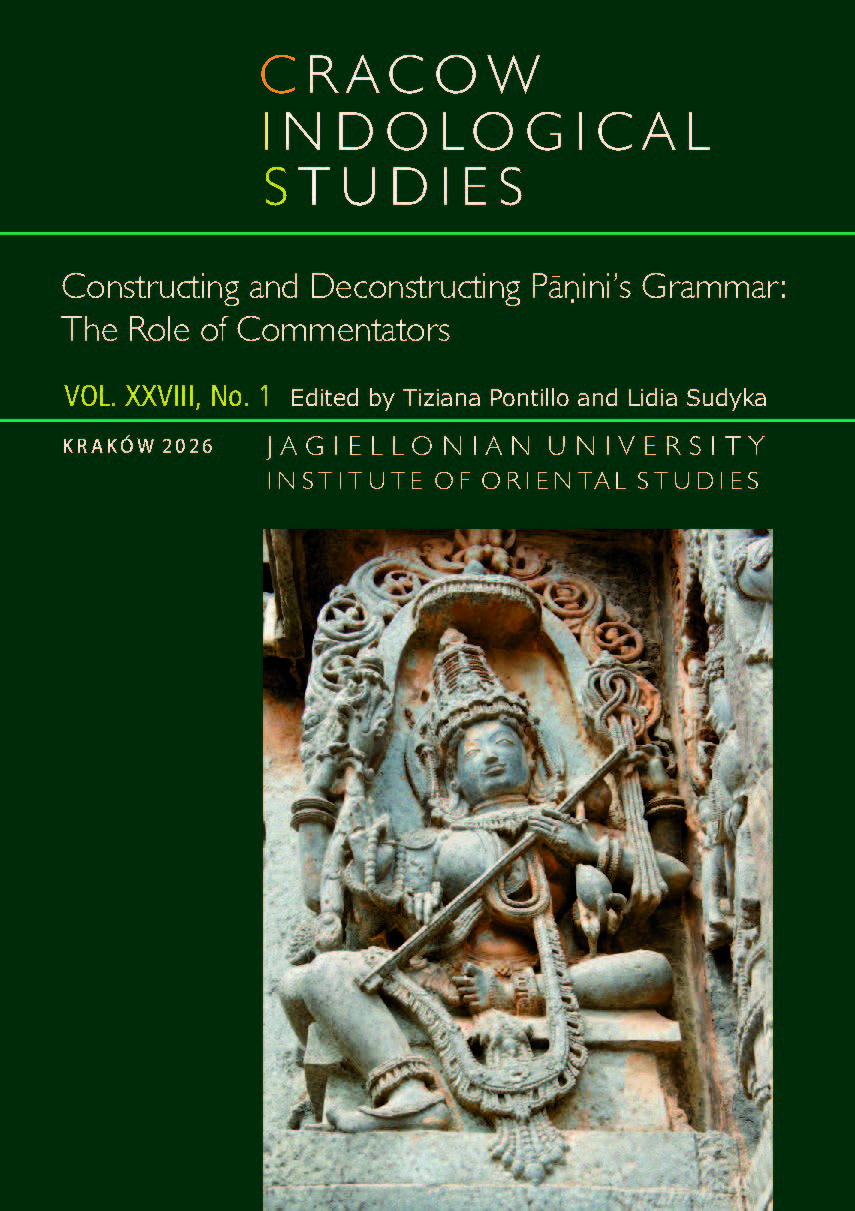
Vol. 28 No. 1 (2026): Constructing and Deconstructing Pāṇini's Grammar: the Role of Commentators
					View Vol. 28 No. 1 (2026): Constructing and Deconstructing Pāṇini's Grammar: the Role of Commentators

Edited by Tiziana Pontillo and Lidia Sudyka

Published: 2026-07-31

Front Matter

  • Front Matter

    DOI: https://doi.org/10.12797/

Introduction

  • Moments and Meanings Remembering Professor Oberhammer Marzenna Czerniak-Drożdżowicz, Ewa Dębicka-Borek, Iwona Milewska and Lidia Sudyka

    Marzenna Czerniak-Drożdżowicz, Ewa Dębicka-Borek, Iwona Milewska, Lidia Sudyka
    V-XIII
    DOI: https://doi.org/10.12797/

Articles

  • Constructing and Deconstructing Pāṇini’s Grammar The Role of Commentators

    Tiziana Pontillo, Lidia Sudyka
    XIX-XXVIII
    DOI: https://doi.org/10.12797/CIS.28.2026.01.01
  • Sanskrit Beyond Pāṇini Pluralistic Perceptions of Grammar in Apāṇinīyaprāmāṇyasādhana

    Chettiarthodi Rajendran
    1-12
    DOI: https://doi.org/10.12797/CIS.28.2026.01.02
  • Reparsing Pāṇini

    Paul Kiparsky
    DOI: https://doi.org/10.12797/CIS.28.2026.01.03
  • Remarks on Negation through the Ages or How Should We Look at Sanskrit Grammatical Tradition?

    Małgorzata Sulich-Cowley
    59-79
    DOI: https://doi.org/10.12797/CIS.28.2026.01.04
  • Pāṇini’s Semantic Hierarchy, or How to Remove the Commentarial Dust from A 2.3.15

    Davide Mocci
    81-109
    DOI: https://doi.org/10.12797/CIS.28.2026.01.05
  • The Rejection of the Variationist System: How Commentators Interpreted Pāṇini’s General Rule on taddhita-derivations

    Tiziana Pontillo
    111-132
    DOI: https://doi.org/10.12797/CIS.28.2026.01.06
  • Why Does the Tradition Approach the Aṣṭādhyāyī the Way It Does? Some Methodological Reflections about Pāṇinian Studies

    Rishi Rajpopat
    133-145
    DOI: https://doi.org/10.12797/CIS.28.2026.01.07
  • Laghupāṇinīyam The Relevance of a navya vyākaraṇa Text in Kerala with a Special Reference to the sarvanāman Section

    Valentina Ferrero
    147-168
    DOI: https://doi.org/10.12797/CIS.28.2026.01.08
  • When Poetic Usage Becomes Normative: On the Interpretation of A 1.3.37

    Andrey Klebanov
    169-189
    DOI: https://doi.org/10.12797/CIS.28.2026.01.09
  • Kumārila’s Engagements with the Pāṇiniyas—Towards any Future Study of Vyākaraṇa’s Presence in Bhāṭṭa Mīmāṃsā

    Monika Nowakowska
    191-221
    DOI: https://doi.org/10.12797/CIS.28.2026.01.10
  • The Reception of Indian Grammatical Tradition in the Indo-European Linguistics The Concept of the Root, the Ablaut and the Laryngeal Theory

    Dariusz R. Piwowarczyk
    223-240
    DOI: https://doi.org/10.12797/CIS.28.2026.01.11
  • Patterns of Substitution in the Zoroastrian Sanskrit Translation of Ogamadecā Linguistic Features of Parsi Sanskrit

    Oskar Podlasiński
    241-257
    DOI: https://doi.org/10.12797/CIS.28.2026.01.12

Back Matter

  • Back Matter

    DOI: https://doi.org/10.12797/
View All Issues