
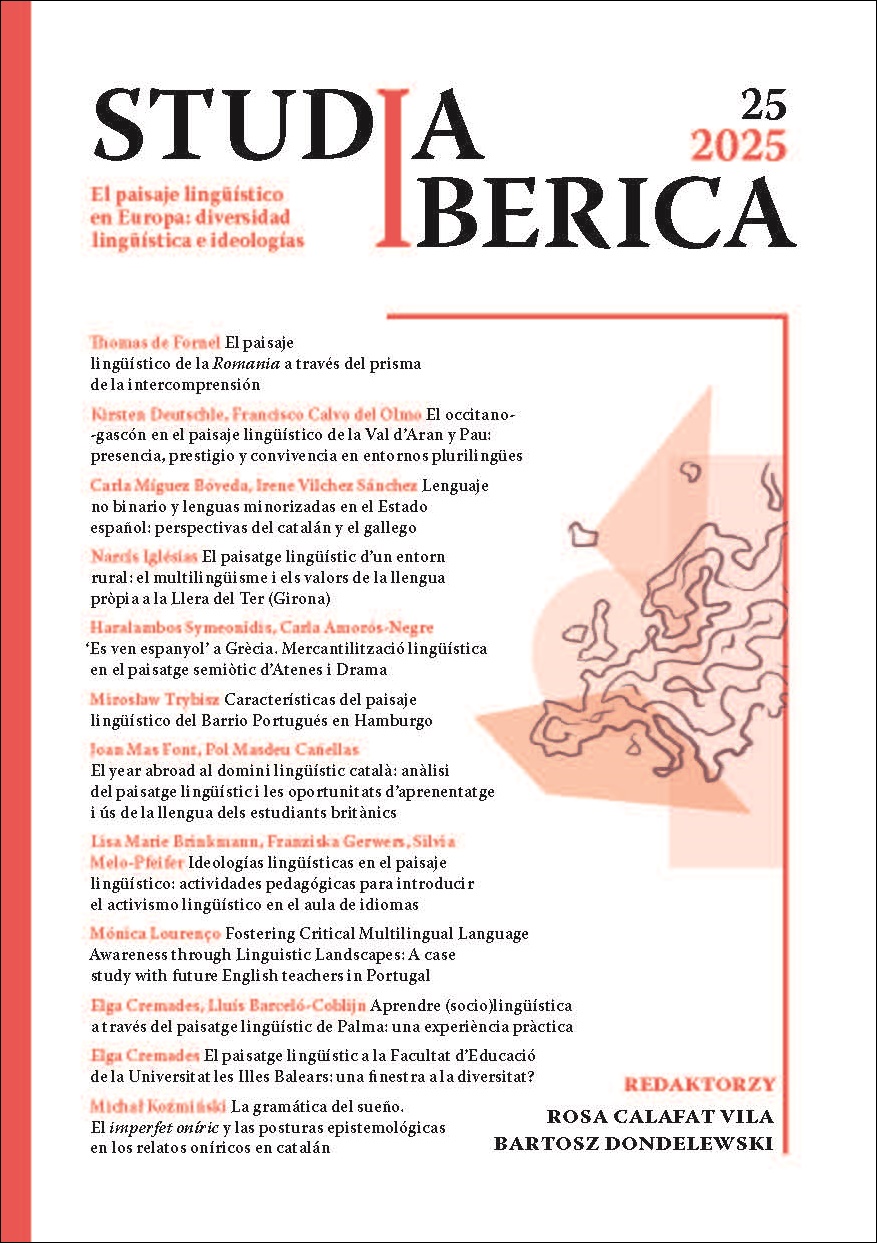
La gramática del sueño
El imperfet oníric y las posturas epistemológicas en los relatos oníricos en catalán
DOI:
https://doi.org/10.12797/SI.25.2025.25.12Keywords:
oneiric imperfect, dreams, epistemological stance, evidentiality, CatalanAbstract
DREAM’S GRAMMAR. IMPERFET ONÍRIC AND EPISTEMOLOGICAL STANCES IN DREAM REPORTS IN CATALAN
In this article, we aim to examine dream narratives found in the Corpus Textual Informatitzat de la Llengua Catalana (CTILC), focusing on the interplay between two aspects: evidentiality and the narrative strategies employed to represent imagined events. We conceptualize dream narratives as a broad and heterogeneous Discursive Tradition, encompassing various types of dream descriptions. Contrary to our expectations, not all of these narratives make use of the so-called “dream imperfect” – a linguistic resource indicating one’s imagination as the origin of the content. Instead, depending on the type of text and the speaker’s pragmatic intention, an epistemological stance is adopted that presents the dream from either a more objective or a more subjective point of view.
References
AIKHENVALD, A. Y. (2004), Evidentiality, Oxford, Oxford University Press. DOI: https://doi.org/10.1093/oso/9780199263882.001.0001
View in Google Scholar
BAJO PÉREZ, E. (2017), “La expresión de la irrealidad en español”, Moenia, 23, 95-146.
View in Google Scholar
BERMÚDEZ, F. (2004), “La categoría evidencial del castellano: metonimia y elevación de sujeto”, Boletín de Lingüística, 22, 3-31.
View in Google Scholar
BERMÚDEZ, F. (2011), “El pluscuamperfecto como marcador evidencial en castellano” [en:] Hernández Socas, E., Sinner, C., Wotjak, G. (eds.), Estudios de tiempo y espacio en la gramática española, Fráncfort del Meno, Peter Lang, 43-62.
View in Google Scholar
BOAS, F. (ed.) (1911), Handbook of American Indian Languages. Part 1, Washington, Government Printing Office.
View in Google Scholar
BONILLA, C. L. (2011), “The Conversational Historical Present in Oral Spanish Narratives”, Hispania, 94(3), 429-442. DOI: https://doi.org/10.1353/hpn.2011.a453991
View in Google Scholar
BÖHM, V. (2015), La imperfectividad en la prensa española y su relación con las categorías semánticas de modalidad y evidencialidad, Potsdam, Peter Lang Edition. DOI: https://doi.org/10.3726/978-3-653-06436-0
View in Google Scholar
COHEN, G., CHUAKAW, C., SMALL, J. (2010), “Waking the Language of Dreamers: A Survey of Evidentiality in Dreams”, University of British Columbia Working Papers in Linguistics, 28, Evidence from Evidentials, 41-73.
View in Google Scholar
Ctilc: Institut d’Estudis Catalans, Corpus textual informatitzat de la llengua catalana, https://ctilc.iec.cat/, 30.02.2022.
View in Google Scholar
CUNHA, L. F. (2021), “Tempos do passado e tempos do futuro em confronto: diferenças e paralelismos”, Revista da Associação Portuguesa de Linguística, 8, 105-120. DOI: https://doi.org/10.26334/2183-9077/rapln8ano2021a8
View in Google Scholar
FLEISCHMAN, S. (1990), Tense and Narrativity: From Medieval Performance to Modern Fiction, Austin, Universidad de Texas.
View in Google Scholar
GARCIA SEBASTIÀ, J. V. (2020), “Intersubjetividad e irrealidad en las fórmulas de inicio de los cuentos: això era y sus variantes en catalán contemporáneo” [en:] Rodríguez Rosique, S., Antolí Martínez, J. M. (eds.), El conocimiento compartido. Entre la pragmática y la gramática, Berlín, De Gruyter, 83-114. DOI: https://doi.org/10.1515/9783110711172-004
View in Google Scholar
Gcc: SOLA, J. Solà, Joan, LLORET, M. R., MASCARÓ, J., PÉREZ SALDANYA,
View in Google Scholar
M. (eds.) (2002), Gramàtica del català contemporani, Barcelona, Empúries.
View in Google Scholar
Gdlc: Grup Enciclopèdia (1998), Gran diccionari de la llengua catalana, Barcelona, Enciclopèdia Catalana, https://www.diccionari.cat, 30.05.2022.
View in Google Scholar
Giec: Institut d’Estudis Catalans (2016), Gramàtica de la llengua catalana, Barcelona, Institut d’Estudis Catalans.
View in Google Scholar
GIORGI, A., PIANESI, F. (2001), “Imperfect dreams: The temporal dependencies of fictional predicates”, Probus, 13, 31-68. DOI: https://doi.org/10.1515/prbs.13.1.31
View in Google Scholar
GUTIÉRREZ ARAUS, M. L. (1995), “Sobre los valores secundarios del imperfecto” [en:] Grande Alija, F. J., Le Men, J., Rueda Rueda, M., Prado Ibán, E. (coords.), Actuales tendencias en la enseñanza del español como lengua extranjera II: actas del VI Congreso Internacional de ASELE: (León 5–7 de octubre de 1995), León, Servicio de Publicaciones, 177-186.
View in Google Scholar
HAVU, J. (2020), “Las formas imperfectivas y perfectivas del verbo románico, estabilidad y cambio”, Quaestiones Romanicae, 8(1), 65-93.
View in Google Scholar
KABATEK, J. (2005), “Tradiciones discursivas y cambio lingüístico”, Lexis, 29(2), 151-177. DOI: https://doi.org/10.18800/lexis.200502.001
View in Google Scholar
KITAGAWA, Ch., LEHRER, A. (1990), “Impersonal uses of personal pronouns”, Journal of Pragmatics, 14(5), 739-759. DOI: https://doi.org/10.1016/0378-2166(90)90004-W
View in Google Scholar
KRACKE, W. H. (2009), “Dream as Deceit, Dream as Truth: The Grammar of Telling Dreams”, Anthropological Linguistics, 51(1), 64-77. DOI: https://doi.org/10.1353/anl.0.0006
View in Google Scholar
LABOV, W. (1972), Language in the inner city, Philadelphia, University of Pennsylvania Press.
View in Google Scholar
MUSHIN, I. (2001), Evidentiality and Epistemological Stance. Narrative retelling, Amsterdam, John Benjamins. DOI: https://doi.org/10.1075/pbns.87
View in Google Scholar
PERELMUTTER, R. (2008), “The Language of Dream Reports and Dostoevsky’s «The Double»”, The Slavic and East European Journal, 52(1), 55-86.
View in Google Scholar
REYES, G. (1990), “Valores estilísticos del imperfecto”, Revista de Filología Española, 70(1-2), 45-70. DOI: https://doi.org/10.3989/rfe.1990.v70.i1/2.676
View in Google Scholar
SCHIFFRIN, D. (1981), “Tense variation in narrative”, Language, 57(1), 45-62. DOI: https://doi.org/10.1353/lan.1981.0011
View in Google Scholar
SILVA-CORVALÁN, C. (1983), “Tense and Aspect in Oral Spanish Narrative: Context and Meaning”, Language, 59(4), 760-780. DOI: https://doi.org/10.2307/413372
View in Google Scholar
SQUARTINI, M. (2004), “Disentangling evidentiality and epistemic modality in Romance”, Lingua, 114, 873-895. DOI: https://doi.org/10.1016/S0024-3841(03)00064-0
View in Google Scholar
SQUARTINI, M. (2008), “Lexical vs. grammatical evidentiality in French and Italian”, Linguistics, 46(5), 917-947. DOI: https://doi.org/10.1515/LING.2008.030
View in Google Scholar
TOURNADRE, N. (1996), “Comparaison des systèmes médiatifs de quatre dialectes tibétains (tibétain central, ladakhi, dzonkha et amdo)” en: Guentchéva, Z. (ed.), L’énonciation médiatisée, Louvain, Paris, Éditions Peeters, 195-213.
View in Google Scholar
WILLETT, Th. (1988), “A cross-linguistic survey of the grammaticalization of evidentiality”, Studies in Language, 12, 51-97. DOI: https://doi.org/10.1075/sl.12.1.04wil
View in Google Scholar
WOLFSON, N. (1979), “The conversational historical present alternation”, Language, 55, 168-182. DOI: https://doi.org/10.2307/412521
View in Google Scholar
Downloads
Published
Issue
Section
License

This work is licensed under a Creative Commons Attribution-NonCommercial-NoDerivatives 4.0 International License.



