
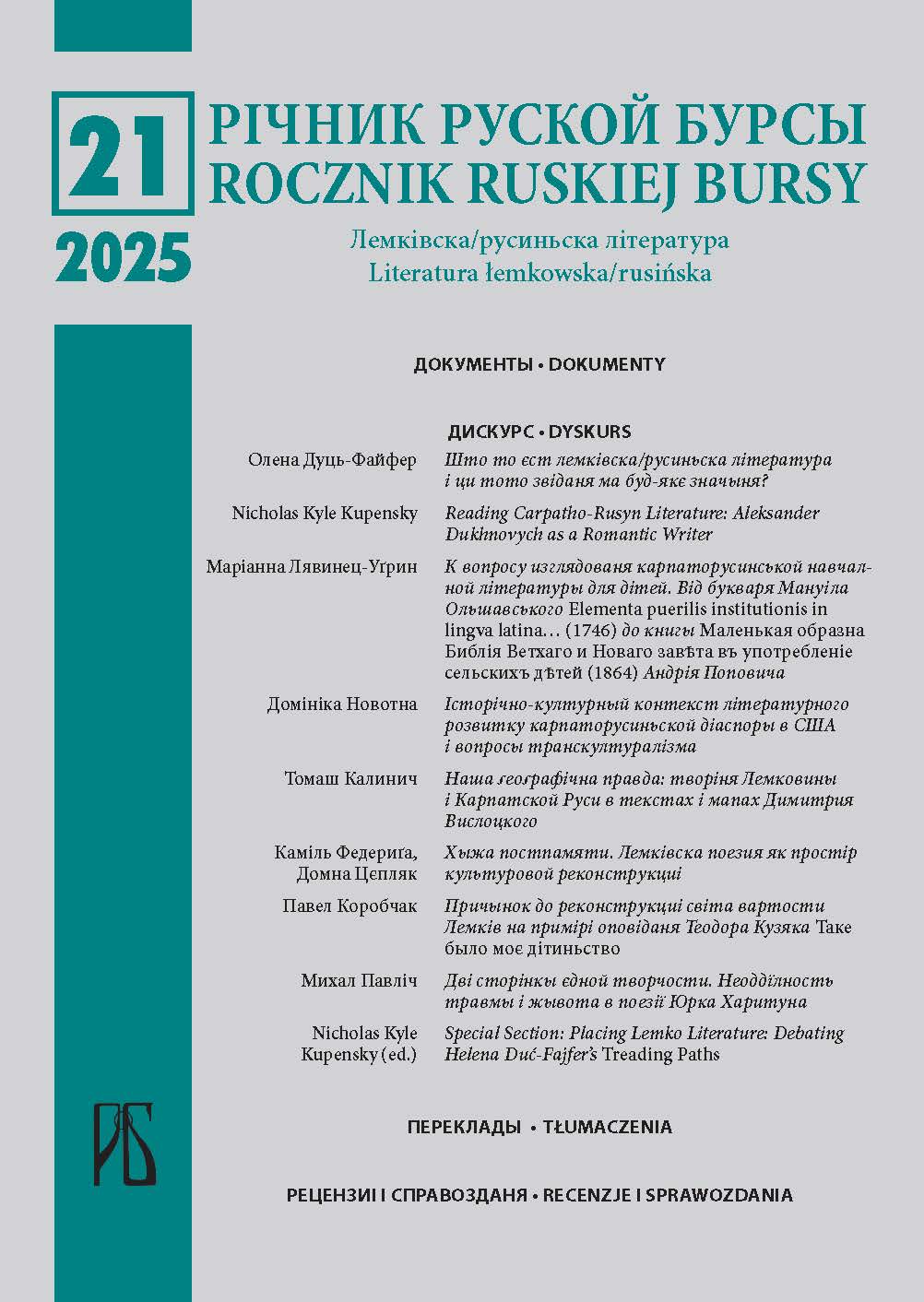
Two Sides of a Single Creative Work: The Inseparability of Trauma and Life in the Poetry of Iurko Kharytun
DOI:
https://doi.org/10.12797/RRB.21.2025.21.08Keywords:
Iurko Kharytun, Rusyn literature, cultural memory, trauma, forced resettlementAbstract
TWO SIDES OF A SINGLE CREATIVE WORK: THE INSEPARABILITY OF TRAUMA AND LIFE IN THE POETRY OF IURKO KHARYTUN
This article offers a comprehensive interpretation of the poetry of Iurko Kharytun (1948–2024), one of the most significant figures of modern Rusyn literature. Previous readings of his work have predominantly emphasized the trauma associated with the forced resettlement of the Starina Valley during the construction of the Starina reservoir, and his works can be described as the “lament of the Rusyn nightingale.” The study, however, argues that this image represents only one dimension of his poetry. Drawing on the concepts of collective and cultural memory, trauma theory, the poetics of space, and reflections of nostalgia, it analyzes poems from the collections Мої жалї (My Sorrows) and Мої незабудкы (My Forget-me-nots). The analysis demonstrates that Kharytun’s poetry functions both as a medium of cultural memory and as an affirmation of life: it preserves the images of a lost homeland while simultaneously celebrating the beauty of simple moments and the vitality of everyday existence. Trauma and the love of daily life thus emerge as two inseparable sides of one creative work, which, in the context of Rusyn literature, serves as an act of cultural resistance and an identity-forming legacy.
References
Харитун, Юрко. 1995. Гуслї з явора. Пряшів: Русиньска оброда [Charytun, Jurko. 1995. Huslji z jawora. Priasziw: Rusyńskaobroda].
Харитун, Юрко. 2010. Мої жалї. Пряшів: Русин і Народны новинкы [Charytun, Jurko. 2010. Moji żalji. Priasziw: Rusyn i Narodnŷ nowynkŷ].
Харитун, Юрко. 2011. Мої сны. Пряшів: Сполок русиньскых писателїв Словеньска [Charytun, Jurko. 2011. Moji snŷ. Priasziw: Społok rusyńskŷch pysateljiw Słoweńska].
Харитун, Юрко. 2013. Мої незабудкы. Пряшів: Сполок русиньскых писателїв Сло-веньска [Charytun, Jurko. 2013. Moji nezabudkŷ. Priasziw: Społok rusyńskŷch pysateljiw Słoweńska].
Харитун, Юрко. 2014. Мої надї ї. Пряшів: Академія русиньской културы в СР [Charytun, Jurko. 2014. Moji nadji ji. Priasziw: Akademija rusyńskoj kułturŷ w SR].
Харитун, Юрко. 2016. Здогадай, школярику. Пряшів: Академія русиньской културы в СР [Charytun, Jurko. 2016. Zdohadaj, szkolaryku. Priasziw: Akademija rusyńskoj kułturŷ w SR].
Харитун, Юрко. (2017) 2023. Дякую, мамко! Пряшів: Обчаньске здружіня Колысоч-ка – Kolíska [Charytun, Jurko. (2017) 2023. Diakuju, mamko! Priasziw: Obczańske zdrużinia Kołŷsoczka – Kolíska].
Харитун, Юрко. 2018a. Діяґноза: фіґлї про дїти. Пряшів: Академія русиньской кул-туры в СР [Charytun, Jurko. 2018a. Dijagnoza: figlji pro djity. Priasziw: Akademija rusyńskoj kuł¬turŷ w SR].
Харитун, Юрко. 2018б. Нашы співаночкы, як дївчат віночкы. Пряшів: Обчаньске здружіня Колысочка – Kolíska [Charytun, Jurko. 2018b. Naszы spiwanoczkŷ, jak djiwczat winoczkŷ. Priasziw: Obczańske zdrużinia Kołŷsoczka – Kolíska].
Assmann, Aleida. 2012. Introduction to Cultural Studies. Topics, Concepts, Issues. Пер. David Henry Wilson. Berlin: Erich Schmidt Verlag.
Assmann, Jan. 2011. Cultural Memory and Early Civilization. Writing, Remembrance, and Political Imagination. Cambridge–New York: Cambridge University Press. https://doi.org/10.1017/cbo9780511996306. DOI: https://doi.org/10.1017/CBO9780511996306
Bachelard, Gaston. 2014. The Poetics of Space. Пер. Maria Jolas. Вступ Richard Kearney. Посл. Marek Z. Danielewski. New York: Penguin Books.
Boym, Svetlana. 2001. The Future of Nostalgia. New York: Basic Books.
Caruth, Cathy. 1996. Unclaimed Experience. Trauma, Narrative, and History. Baltimore–London: Johns Hopkins University Press. https://doi.org/10.1353/book.20656. DOI: https://doi.org/10.1353/book.20656
Halbwachs, Maurice. 1950. La mémoire collective. Paris: Presses Universitaires de France.
Iser, Wolfgang. 2001. The Range of Interpretation. New York: Columbia University Press.
LaCapra, Dominick. 2014. Writing History, Writing Trauma. Baltimore: Johns Hopkins University Press. https://doi.org/10.56021/9781421414003. DOI: https://doi.org/10.56021/9781421414003
«Nostalgia». 1998. В: The New Oxford Dictionary of English. Pед. Judy Pearsall, 1266. Oxford: Oxford University Press.
Tal, Kalí. 1996. Worlds of Hurt. Reading the Literatures of Trauma. Cambridge: Cambridge University Press.
Downloads
Published
Issue
Section
License
Copyright (c) 2025 Rocznik Ruskiej Bursy

This work is licensed under a Creative Commons Attribution 4.0 International License.