Przejdź do sekcji głównej
Przejdź do głównego menu
Przejdź do stopki
Open Menu
Aktualny numer
Archiwum
Ogłoszenia
Przesyłanie tekstów
Wskazówki dla Autorów
Proces recenzyjny i recenzenci
Kontrola antyplagiatowa
Polityka wykorzystania narzędzi generatywnej SI
Proces wydawniczy
Prawa autorskie i zasady udostępniania
Polityka prywatności
Opłaty redakcyjne
Polityka open access
O czasopiśmie
O czasopiśmie
Zespół redakcyjny
Zasady etyki wydawniczej
Kontakt
Szukaj
Zarejestruj
Zaloguj
Strona domowa
/
Archiwum
/
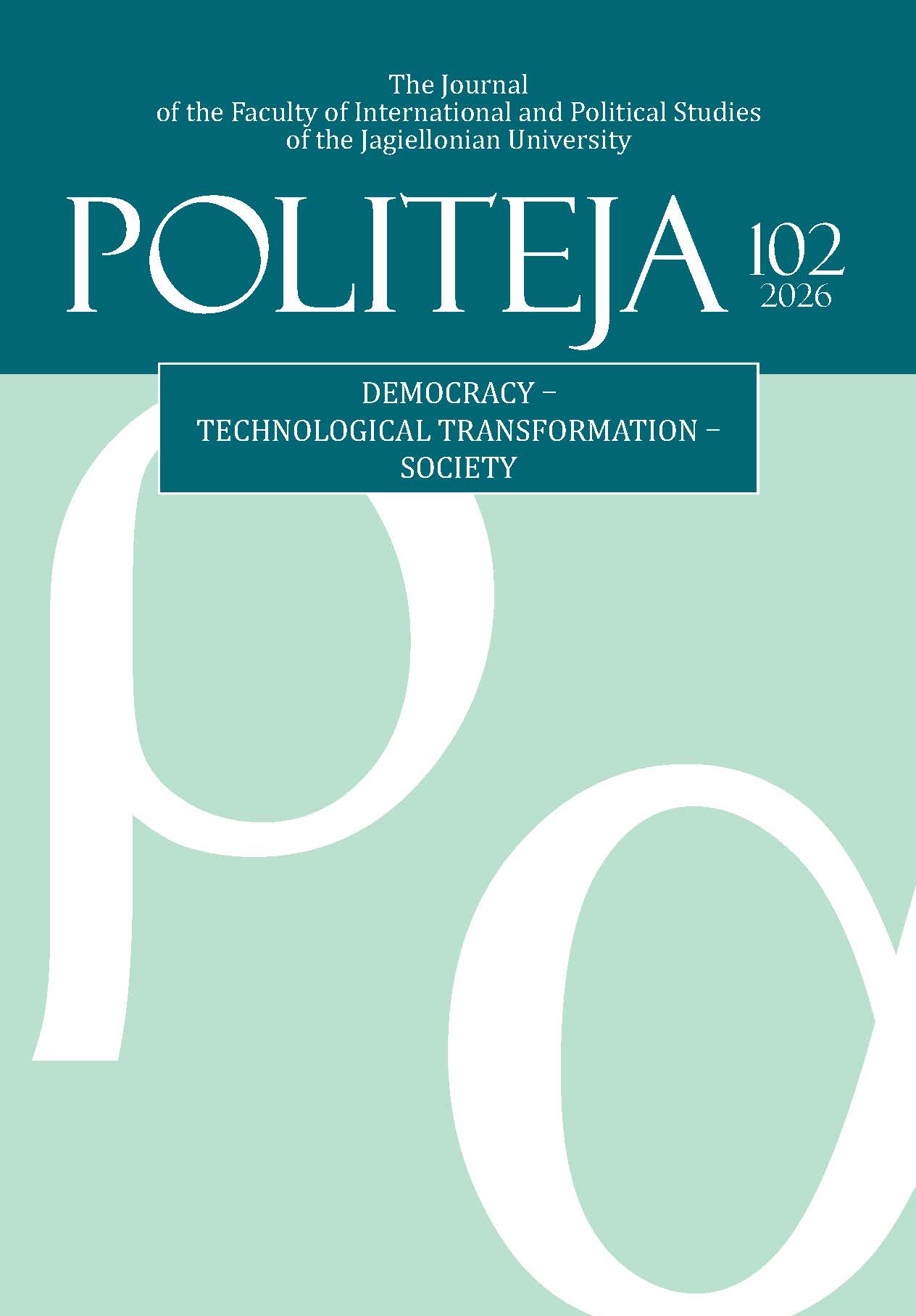
Tom 23 Nr 2(102) (2026): Democracy – Technological Transformation – Society
Tom 23 Nr 2(102) (2026): Democracy – Technological Transformation – Society
Edited by Monika Banaś, Małgorzata Kiwior-Filo
Opublikowane:
29-05-2026
Front Matter
Front Matter
PDF (Angielski)
Wstęp
Introduction
Monika Banaś, Małgorzata Kiwior-Filo
5-7
PDF (Angielski)
Artykuły
Power of the Demos or Power over the Demos – Condition, Consolidation, Leadership and Threats of Modern Democracy in Political Science Discourse
Alessandro Campi, Małgorzata Kiwior-Filo, Mateusz Mach
9-31
PDF (Angielski)
DOI:
https://doi.org/10.12797/Politeja.23.2026.102.01
The Fragility of Democracy and Its Double-Edged Nature
Jakub Polit
33-48
PDF (Angielski)
DOI:
https://doi.org/10.12797/Politeja.23.2026.102.02
Anti-Politics as a Quasi-Regulative Idea
Dariusz Juruś
49-63
PDF (Angielski)
DOI:
https://doi.org/10.12797/Politeja.23.2026.102.03
The Liberal Trap
How Democratic Discourse Enables Illiberal Politics
Alessandro Fanì
65-74
PDF (Angielski)
DOI:
https://doi.org/10.12797/Politeja.23.2026.102.04
The Culture of Anti-Politics in Poland
Between Democratization and Autocratization
Jacek Ziółkowski
75-103
PDF (Angielski)
DOI:
https://doi.org/10.12797/Politeja.23.2026.102.05
From Solidarność to the Algorithm
The Crisis of Intermediate Bodies in Poland between Trade Union Legacy and the Challenges of AI
Mirela Marta Banach, Antonio Macchia
105-128
PDF (Angielski)
DOI:
https://doi.org/10.12797/Politeja.23.2026.102.06
Crisis of Liberal Democracy in the United States
Mike Kohout
129-140
PDF (Angielski)
DOI:
https://doi.org/10.12797/Politeja.23.2026.102.07
Language, Populism, and Political Discourse in Contemporary Europe
The Dutch Case
Monika Banaś, Raúl Sánchez Prieto
141-160
PDF (Angielski)
DOI:
https://doi.org/10.12797/Politeja.23.2026.102.08
‘Achilles’ Heel’ and Democratic Society
A Corpora Analysis of Journalistic Texts
Jana Pecníková, Anita Huťková, Miriam Pavlovičová
161-173
PDF (Angielski)
DOI:
https://doi.org/10.12797/Politeja.23.2026.102.09
Radicalism, Extremism, and Terrorism
Terminological Explanations and Their Role in Anti-Democratic Movements
Violetta Gul-Rechlewicz
175-193
PDF (Angielski)
DOI:
https://doi.org/10.12797/Politeja.23.2026.102.10
‘Dirty’ Right-Wing Populist Leader
Between Moral Relativism and Cynical Practices of Leadership Authority
Filip Pierzchalski, Mark J. Kaswan
195-213
PDF (Angielski)
DOI:
https://doi.org/10.12797/Politeja.23.2026.102.11
The Digital Age of Political Engagement
Social Media, Political Exposure, and the Challenges of the Digital Public Sphere
Pablo Esteban López Fernández, Carolina Plaza-Colodro
215-232
PDF (Angielski)
DOI:
https://doi.org/10.12797/Politeja.23.2026.102.12
Democracy as Telecracy?
Bernard Stiegler on the Erosion of Democracy
Piotr Rutkowski
233-253
PDF (Angielski)
DOI:
https://doi.org/10.12797/Politeja.23.2026.102.13
The Challenges of Technological Development after 2020 and the Crisis of Liberal Democracy in Bulgaria
Desislava Damyanova
255-266
PDF (Angielski)
DOI:
https://doi.org/10.12797/Politeja.23.2026.102.14
Threats and Opportunities of Technocracy in the Era of Artificial Intelligence
Helena Jańczuk
267-279
PDF (Angielski)
DOI:
https://doi.org/10.12797/Politeja.23.2026.102.15
Who Controls the Buttons? Algomorphic Society, Technocracy, and Italian Politics
Edmondo Grassi
281-291
PDF (Angielski)
DOI:
https://doi.org/10.12797/Politeja.23.2026.102.16
Joycean Machines Democracy
The Hybridization Process of Contemporary Liberal Democracy in the Context of AI Technology
Piotr Łukomski
293-308
PDF (Angielski)
DOI:
https://doi.org/10.12797/Politeja.23.2026.102.17
Can AI Save Democracy?
From Militant Democracy to Cyberocracy
Łukasz Wordliczek
309-325
PDF (Angielski)
DOI:
https://doi.org/10.12797/Politeja.23.2026.102.18
Artificial Authority: From Machine Minds to Political Alignments
An Experimental Analysis of Democratic and Autocratic Biases in Large-Language Models
Natalia Ożegalska-Łukasik, Szymon Łukasik
327-350
PDF (Angielski)
DOI:
https://doi.org/10.12797/Politeja.23.2026.102.19
Young EU Citizens’ Perception of Democracy and European Security in the Age of Artificial Intelligence and Global Threats
Marta Dębska
351-364
PDF (Angielski)
DOI:
https://doi.org/10.12797/Politeja.23.2026.102.20
Back Matter
Back Matter
351-364
PDF (Angielski)
Make a Submission
Make a Submission
Język / Language
English
Polski
Latest publications
homepage